Shelf Sag Calculator
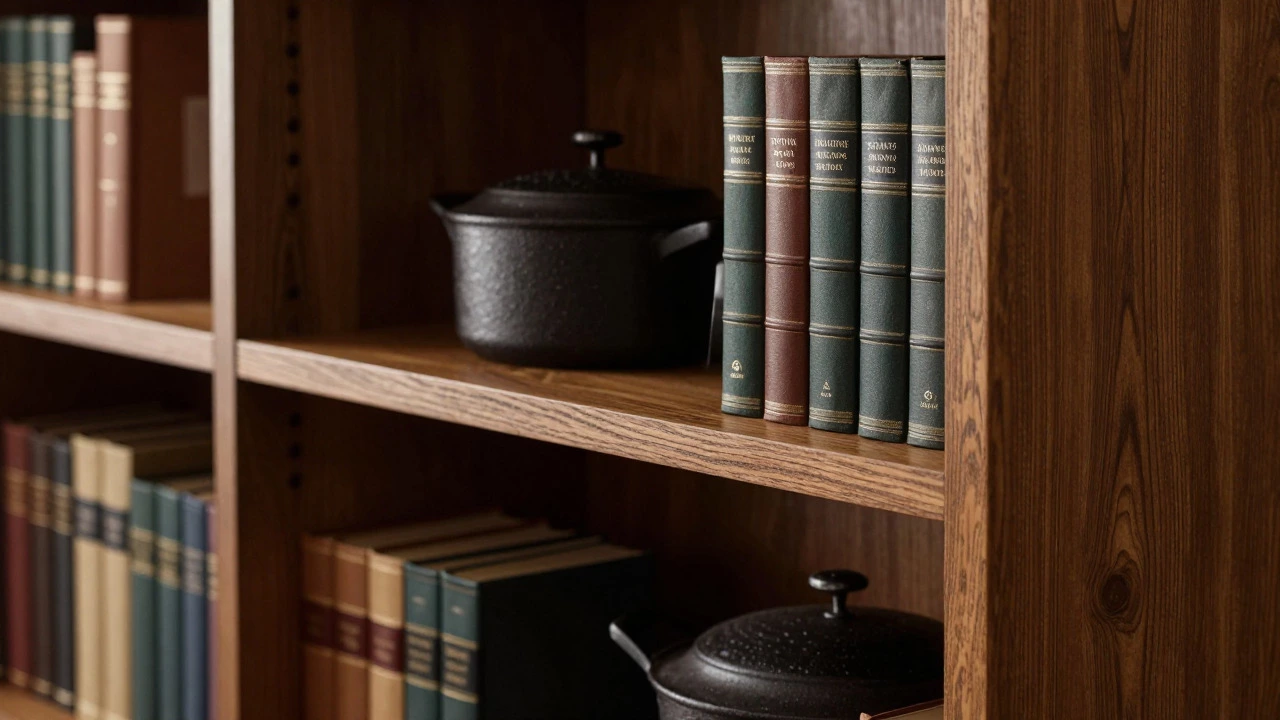
You’ve built the perfect bookshelf or pantry rack, loaded it with heavy cookbooks and cast-iron skillets, and three months later, you notice a subtle smile forming in the middle of your shelf. It’s not just unsightly; it’s a structural warning. Shelf sagging is the silent killer of DIY projects and store-bought furniture alike. The culprit isn’t always bad construction-it’s often the wrong choice of wood.
Picking the right material isn’t just about aesthetics. It’s an engineering decision based on stiffness, density, and how the grain runs. If you want shelves that stay flat under weight, you need to understand which woods have the highest modulus of elasticity (MOE)-the fancy term for stiffness-and how to cut them to maximize that strength.
Why Shelves Sag: The Physics of Wood
Before we pick winners, let’s look at why this happens. Wood is an anisotropic material, meaning its properties change depending on the direction you measure them. It is incredibly strong along the grain but weak across it. When you place a load on a horizontal board, gravity pulls down, creating tension on the bottom edge and compression on the top edge. If the wood isn’t stiff enough to resist this bending force, it deforms permanently over time.
The key metric here is the Modulus of Elasticity (MOE). A higher MOE number means the wood resists bending better. However, MOE alone doesn’t tell the whole story. You also need to consider the Modulus of Rupture (MOR), which measures how much stress the wood can take before it actually breaks. For shelving, you want high stiffness (MOE) to prevent visible bowing, even if the shelf never reaches the breaking point.
Another critical factor is span. A 36-inch shelf behaves very differently than a 72-inch shelf. As the distance between supports doubles, the required thickness increases exponentially, not linearly. This is why understanding the specific characteristics of different wood species is vital for long-term durability.
The Gold Standard: Hardwoods for Heavy Loads
If you are building shelves for a library, a garage tool rack, or a heavy kitchen pantry, hardwoods are your best bet. They are dense, stiff, and hold screws well. Here are the top performers.
| Wood Species | Stiffness (MOE) | Density | Best Use Case |
|---|---|---|---|
| White Oak | High (1.80 million psi) | Very High | Heavy-duty industrial shelves |
| Hard Maple | Very High (1.83 million psi) | High | Kitchen cabinets, workshop benches |
| Hickory | Extreme (1.85+ million psi) | Very High | Tool storage, extreme loads |
| Red Oak | High (1.79 million psi) | Medium-High | General purpose bookshelves |
| Birch | High (1.76 million psi) | Medium | Budget-friendly hardwood option |
Hard Maple is widely considered one of the stiffest domestic hardwoods. Its fine, uniform grain structure provides consistent strength without weak spots. It’s expensive, but for a shelf that needs to hold hundreds of pounds of books without showing any curve, maple is hard to beat. It also takes stains beautifully, though it can blotch if not pre-conditioned.
White Oak is another powerhouse. Unlike Red Oak, White Oak has closed cells, making it more resistant to moisture. This makes it ideal for basements or kitchens where humidity might fluctuate. It is slightly less stiff than maple but still far superior to softwoods. The open grain pattern adds visual interest, but be aware that dust from sanding white oak can clog screens quickly.
For pure brute strength, Hickory is unmatched among common domestic woods. It is tough, resilient, and incredibly stiff. However, hickory has a wild, contrasting grain that can make it difficult to work with. It tears out easily if your blades aren’t razor-sharp, and the color variation can look chaotic if you’re aiming for a minimalist aesthetic. Save hickory for utility sheds or workshops where function trumps form.
The Smart Alternative: Engineered Woods
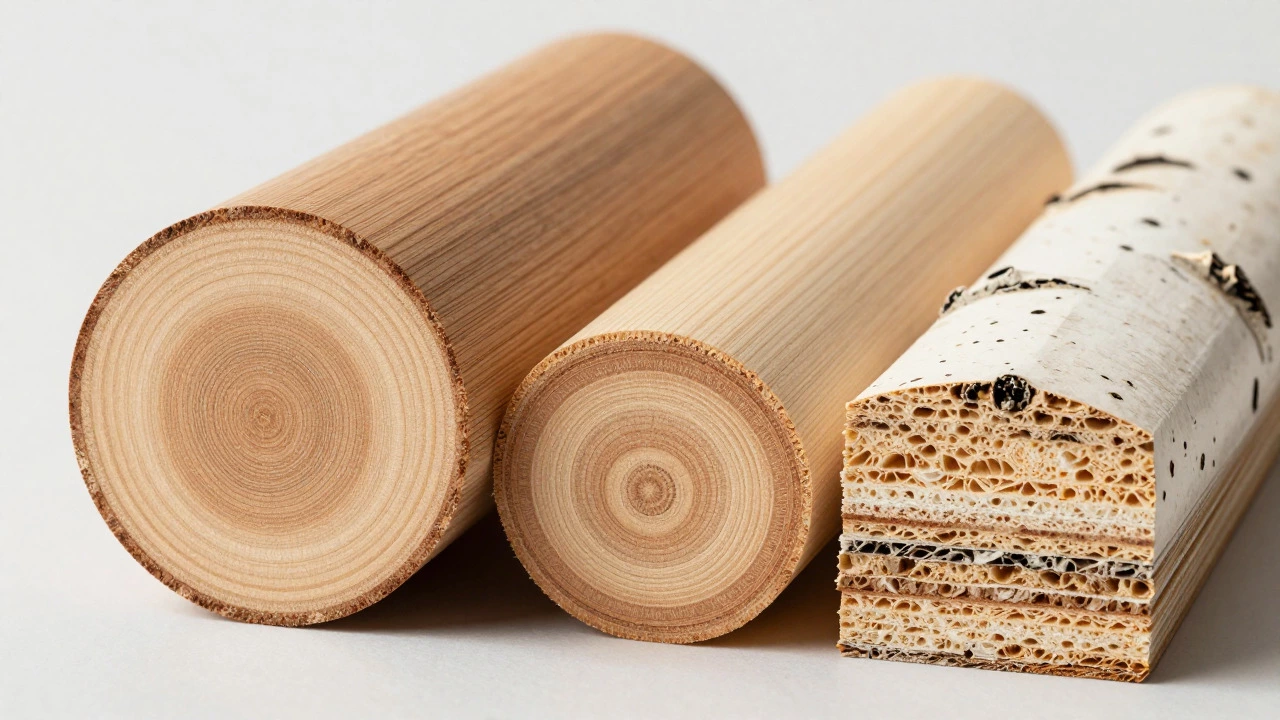
Here is a counter-intuitive truth: solid wood isn’t always the best choice for long spans. In fact, for wide shelves (over 36 inches), engineered woods like plywood and MDF often outperform solid lumber because they eliminate the natural weaknesses found in solid boards, such as knots and grain irregularities.
Plywood, specifically Baltic Birch or high-grade Sanded Plywood, is a favorite among professional cabinet makers. Because plywood is made of thin layers of wood veneer glued together with alternating grain directions, it has incredible dimensional stability. It doesn’t warp or twist like solid wood can. More importantly, it has a very high stiffness-to-weight ratio. A 3/4-inch sheet of Baltic Birch will resist sagging better than a 3/4-inch board of Red Oak over a 4-foot span.
The downside? Edges. Raw plywood edges look ugly. You’ll need to apply edge banding or solid wood trim to hide the layered core. But structurally, it is a beast. If you are building a large entertainment center or a wall-to-wall bookcase, plywood is the smarter engineering choice.
MDF (Medium Density Fiberboard) is another option, but with caveats. MDF is extremely dense and uniform, so it doesn’t sag easily. However, it is heavy and absorbs moisture like a sponge. If your environment is humid, MDF will swell and lose strength. Stick to MDF only for dry, indoor environments, and always seal it thoroughly.
Softwoods: Proceed with Caution
We all love the look and affordability of pine, fir, and spruce. These softwoods are easy to cut and cheap to buy. But if you use standard 1x10 or 1x12 boards from the hardware store, expect sagging within a year if you load them up.
Softwoods have a lower MOE. Pine, for example, has roughly half the stiffness of Maple. To compensate, you have two options: reduce the span significantly (keep shelves under 24 inches) or increase the thickness drastically. A 2-inch thick pine shelf will perform similarly to a 1-inch thick maple shelf. So, if you must use pine, buy thicker stock-like 2x10s or 2x12s-and plane them down if needed for finish.
Also, select your boards carefully. Look for straight grain. Avoid boards with large knots or wavy grain patterns, as these create weak points where the shelf is most likely to fail. Clear grades of pine are stiffer than construction-grade lumber full of defects.
Design Rules to Prevent Sagging
Choosing the right wood is only half the battle. How you design and install the shelf matters just as much. Even the strongest wood will sag if the geometry is wrong.
- Thickness Matters Most: Doubling the width of a shelf adds little strength. Doubling the thickness quadruples its resistance to bending. Always prioritize vertical thickness over horizontal width.
- Limit the Span: Keep unsupported spans under 32 inches for heavy loads. If you need wider shelves, add a center support bracket or a stile.
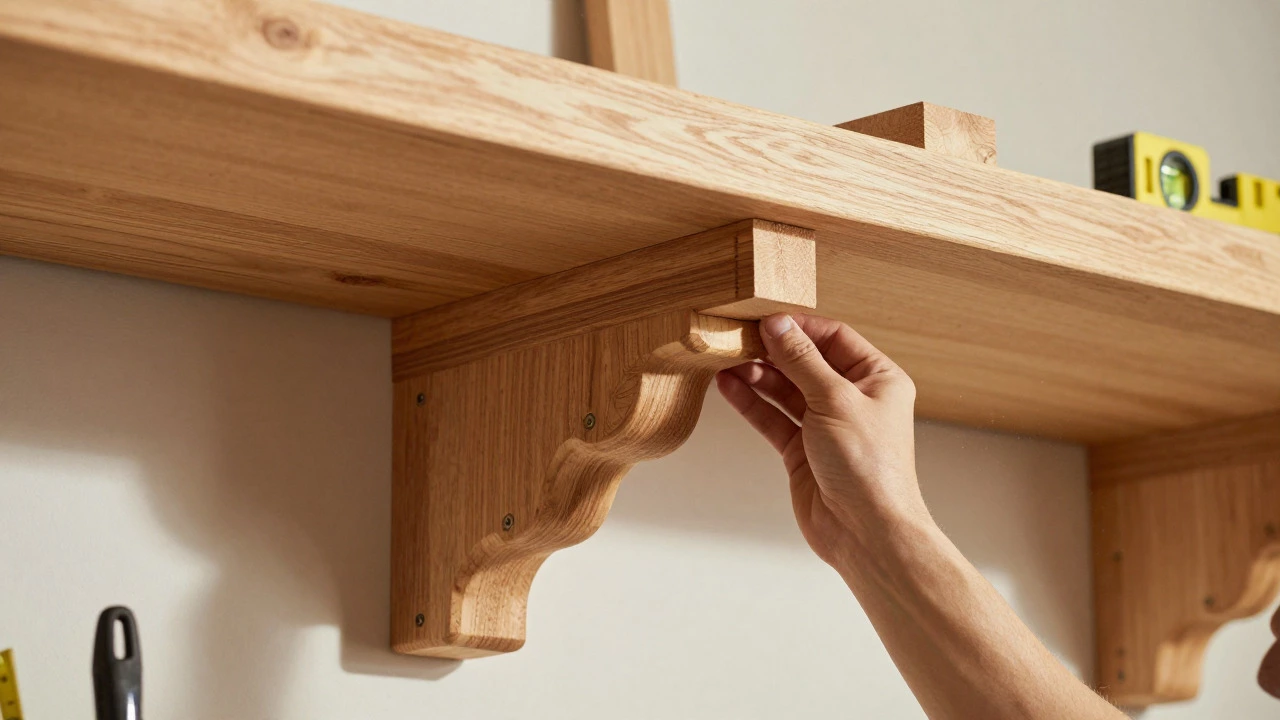
- Use Corbels: Decorative corbels aren’t just pretty; they act as cantilever supports that dramatically reduce the effective span of the shelf. Place them within 2 inches of the edge for maximum effect.
- Glue-Up Panels: If you want a wide, solid wood shelf, glue multiple narrower boards together. This distributes stress evenly and prevents the twisting that happens with single wide planks.
- Face Frame Support: If your shelf sits inside a cabinet with a face frame, ensure the shelf rests directly on the face frame rails, not just on side panels. This creates a continuous bearing surface.
Maintenance and Environmental Factors
Wood is a living material that reacts to its environment. Fluctuations in humidity cause wood to expand and contract. While this usually affects width more than length, severe changes can lead to warping or checking (cracks), which compromise structural integrity.
Keep your shelving units away from direct heat sources like radiators or sunny windows. In very dry climates, use a humidifier to keep relative humidity between 40% and 50%. In damp basements, ensure good ventilation to prevent mold and rot, especially if using porous woods like Red Oak.
Regularly check the fasteners. Over time, the weight of the contents can loosen screws or nails. Tighten them annually to maintain rigidity. If you hear creaking, it’s often a sign of joint failure or friction between moving parts, not necessarily sagging, but it indicates stress in the system.
What is the absolute strongest wood for shelves?
Among commonly available domestic woods, Hickory and Hard Maple are the stiffest and strongest. Hickory has the highest Modulus of Elasticity, making it extremely resistant to bending. However, Hard Maple is often preferred for furniture due to its smoother texture and easier workability while offering nearly identical strength.
Will plywood sag less than solid wood?
Yes, for wide spans, high-quality plywood like Baltic Birch often sags less than solid wood of the same thickness. Plywood’s cross-laminated structure provides superior dimensional stability and consistent stiffness across the entire sheet, eliminating weak spots caused by knots or grain variations found in solid lumber.
How thick should my shelves be to prevent sagging?
For standard bookshelves with spans up to 32 inches, 3/4-inch thick material is generally sufficient. For spans between 32 and 48 inches, you should use 1-inch thick material or add center supports. For spans over 48 inches, consider using 1.5-inch thick stock or adding intermediate brackets every 24 inches.
Can I fix a sagging shelf without replacing it?
Minor sagging can sometimes be corrected by adding support brackets or corbels underneath. If the wood hasn’t permanently deformed, removing the weight and allowing it to rest flat for several weeks may help it return to shape. However, if the wood has creased or cracked, replacement is the only permanent solution.
Is Red Oak good for heavy shelves?
Red Oak is a good choice for general-purpose shelving. It is harder and stiffer than pine or fir, making it suitable for books and moderate loads. However, for extremely heavy loads or wide spans, White Oak or Maple are superior choices due to their higher stiffness and better moisture resistance.